Advantages and Disadvantages of Arrays
A Detailed Analysis for Better Data Structure Selection
Introduction
Arrays are one of the most commonly used data structures in programming. Their simplicity, speed, and memory layout make them ideal for many applications. However, arrays are not always the best choice. To use arrays effectively, it is important to understand both their strengths and their limitations.
This article provides a detailed analysis of the advantages and disadvantages of arrays, along with comparisons to other data structures where relevant.
Advantages of Arrays
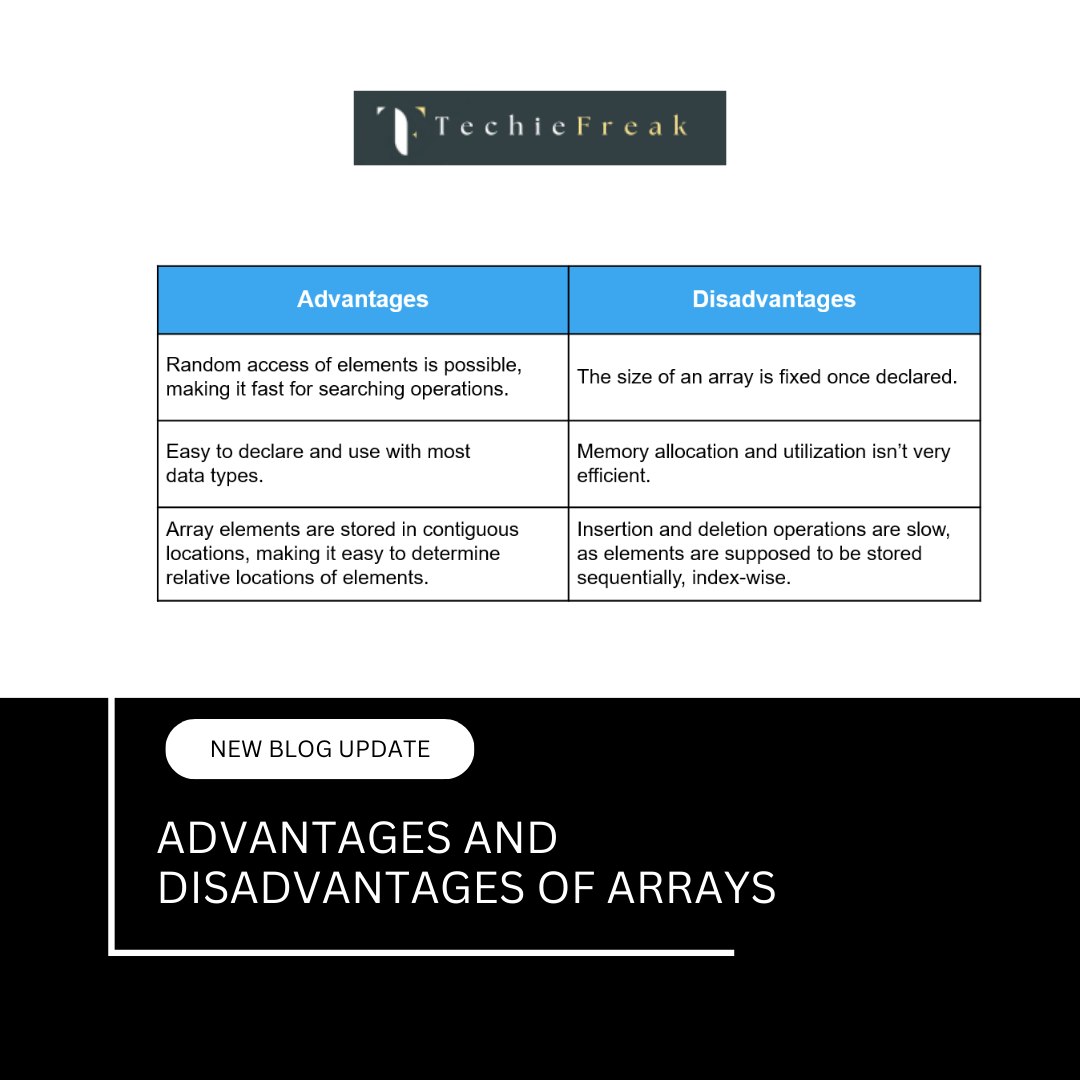
1. Fast Random Access
The biggest advantage of arrays is direct access to elements.
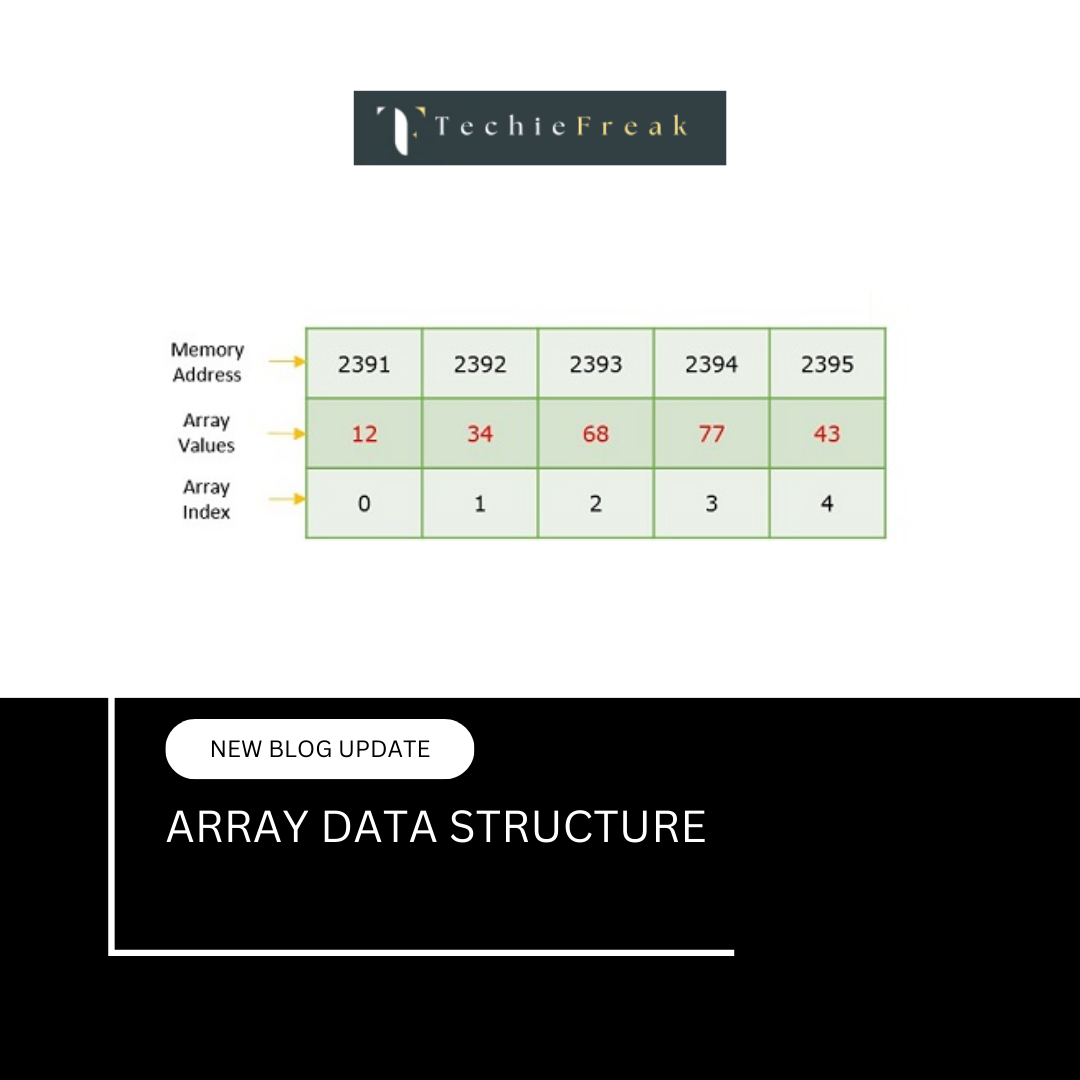
Because array elements are stored in contiguous memory locations, the address of any element can be calculated instantly using its index.
- Access time does not depend on array size
- No traversal is required
Time Complexity:
O(1)
This makes arrays ideal for scenarios where frequent read operations are required.
2. Efficient Memory Utilization
Arrays store elements without extra memory overhead (in primitive arrays).
- No pointers required (unlike linked lists)
- Minimal memory wastage
- Predictable memory layout
This is especially important in:
- Embedded systems
- Low-level programming
- Performance-critical applications
3. Cache-Friendly Data Structure
Modern CPUs use caching to speed up memory access.
Because array elements are stored contiguously:
- Nearby elements are loaded into cache together
- Sequential access becomes extremely fast
This property is called spatial locality and gives arrays a significant performance advantage during traversal.
4. Simple and Easy to Use
Arrays are:
- Easy to declare
- Easy to access
- Easy to traverse
This simplicity makes arrays beginner-friendly and suitable for implementing basic algorithms.
5. Foundation for Other Data Structures
Many advanced data structures are built using arrays, such as:
- Stack
- Queue
- Heap
- Hash Table
- Graph adjacency lists
Understanding arrays is essential to mastering these structures.
6. Suitable for Fixed-Size Data
When the size of data is known in advance and does not change:
- Arrays provide excellent performance
- No resizing overhead is involved
Disadvantages of Arrays
1. Fixed Size (Static Arrays)
In static arrays:
- Size must be declared in advance
- Cannot be increased or decreased later
This can lead to:
- Memory wastage (if size is overestimated)
- Overflow errors (if size is underestimated)
2. Costly Insertion Operations
Inserting an element:
- At the beginning
- Or in the middle
requires shifting existing elements to maintain order.
Time Complexity:
O(n)
This makes arrays inefficient for frequent insertions.
3. Costly Deletion Operations
Deleting an element also requires shifting elements to fill the gap.
Time Complexity:
O(n)
This limits array usage in applications with frequent deletions.
4. Homogeneous Data Storage
Traditional arrays store elements of only one data type.
This makes arrays less flexible compared to structures that support heterogeneous data.
5. Contiguous Memory Requirement
Arrays require a continuous block of memory.
For large arrays:
- Contiguous memory may not be available
- Memory allocation may fail
This problem becomes more prominent in low-memory environments.
Arrays vs Linked Lists (Brief Comparison)
| Feature | Array | Linked List |
|---|---|---|
| Memory Layout | Contiguous | Non-contiguous |
| Access | Fast (O1) | Slow (On) |
| Insertion | Costly | Efficient |
| Deletion | Costly | Efficient |
| Cache Friendly | Yes | No |
When to Use Arrays
Arrays are best when:
- Frequent access is required
- Data size is known
- Insertions/deletions are rare
- Performance is critical
When Not to Use Arrays
Avoid arrays when:
- Data size changes frequently
- Insertions/deletions are common
- Memory flexibility is required
Relationship with Other Topics
This topic is closely related to:
- Array Operations and Time Complexity
- Applications of Arrays
- Linked List Data Structure
What to Read Next
Understanding advantages and disadvantages helps decide where arrays should be used. The next step is to explore real-world and programming applications of arrays.
Next Topic:
Applications of Arrays
Applications of Arrays
Real-World and Programming Use Cases
Introduction
Arrays are not just theoretical concepts; they are used extensively in real-world software systems. From simple data storage to complex algorithmic solutions, arrays play a central role in computer science and engineering.
This article explores the practical applications of arrays across different domains.
1. Data Storage and Management
Arrays are used to store:
- Lists of numbers
- Student records
- Sensor readings
- Configuration values
They provide fast access and efficient storage when data size is known.
2. Implementing Other Data Structures
Arrays form the backbone of many data structures:
- Stack (array-based stack)
- Queue (circular array)
- Heap (priority queue)
- Hash table (bucket storage)
Without arrays, these structures would not perform efficiently.
3. Searching and Sorting Algorithms
Arrays are heavily used in:
- Binary search
- Linear search
- Sorting algorithms (Quick sort, Merge sort, Heap sort)
Most algorithm textbooks and interview problems assume array-based input.
4. Matrix and Table Representation
Two-dimensional arrays are used to represent:
- Matrices
- Tables
- Game boards
- Spreadsheets
Matrix operations in scientific computing rely heavily on arrays.
5. Image Processing
Images are stored as arrays of pixels.
- Grayscale images → 2D arrays
- Color images → 3D arrays
Operations like filtering, resizing, and compression are performed using arrays.
6. Dynamic Programming Problems
Dynamic programming relies on arrays to:
- Store intermediate results
- Avoid recomputation
- Optimize recursive solutions
Examples include:
- Fibonacci sequence
- Knapsack problem
- Longest common subsequence
7. Competitive Programming
Arrays are the most used data structure in competitive programming.
They are used in:
- Prefix sum problems
- Sliding window techniques
- Two pointer approaches
- Frequency counting
8. System-Level Programming
Operating systems use arrays for:
- Memory management tables
- Process scheduling
- Resource tracking
Arrays provide predictable performance, which is crucial at the system level.
9. Graph Representation
Graphs are often represented using:
- Adjacency matrix (2D array)
- Adjacency list (array of lists)
The choice depends on graph density and operations required.
10. Real-Time Applications
Arrays are preferred in real-time systems because:
- They offer deterministic access time
- Memory usage is predictable
This is important in:
- Embedded systems
- Robotics
- Automotive software
Why Arrays Are Still Relevant
Despite newer data structures:
- Arrays remain fast
- Arrays remain simple
- Arrays remain fundamental
Almost every high-level structure relies on arrays internally.
Relationship with Other Topics
This topic connects to:
- Advantages and Disadvantages of Arrays
- Arrays in Different Programming Languages
- Array Problem Solving Techniques
What to Read Next
After understanding applications, the next logical step is to learn how arrays behave in specific programming languages.
.png)
.png)
.png)
.png)
.png)
.png)
.png)
.png)
.png)
.png)
.png)
.png)
.png)
.png)
.png)
.png)
.png)
.png)
.png)
.png)
.png)
.png)
.png)
.png)
.png)
.png)
.png)
.png)
.png)
.png)
.png)
.png)
.png)
.png)
.png)
.png)
.png)
.png)
.png)
.png)
.png)
.png)
.png)
.png)
.png)
.png)
.png)
.png)
.png)
.png)
.png)
.png)
.png)
.png)
.png)
.png)
.png)
.png)
.png)
.png)
.png)
.png)
.png)
.png)
.png)
.png)
.png)
.png)
.png)
.png)
.png)
.png)
.png)
.png)
.png)
.png)
.png)
.png)
.png)
.png)
.png)
.png)
.png)
.png)
.png)
.png)
.png)
.png)
.png)
.png)
.png)
.png)
.png)
.png)
.png)
.png)
.png)
.png)
.png)
.png)
.png)
.png)
.jpg)
.png)
.jpg)
.jpg)
.png)