.png)
PYTHON AND DATABASES
Modern software is built around data. Whether it is user information, product catalogs, analytics logs, financial transactions, machine learning datasets, or authentication details—nearly every Python program interacts with a database at some point. Understanding how Python communicates with databases is a fundamental skill for developers, data analysts, backend engineers, automation experts, and system architects.
This chapter provides an exhaustive, step-by-step exploration of how Python works with SQL and NoSQL databases, covering topics like drivers, ORMs, connection pooling, transactions, indexing, query performance, schema design, security considerations, and real-world architecture patterns. We will explore:
- SQL Basics
- SQLite
- MySQL
- PostgreSQL
- MongoDB
- Redis
- ORMs (SQLAlchemy, Django ORM)
- Connection pooling
- Migration tools
- Query optimization
- Safe database access patterns
- Architecting database-driven Python applications
This chapter bridges theory with hands-on code and teaches you not only how to run queries, but how to think about databases professionally.
Introduction to Databases in Python
A database is an organized system for storing, retrieving, and managing structured or unstructured data. Python does not include its own database engine but connects to many powerful systems across the SQL and NoSQL world.
Python interacts with databases using:
- Database Drivers (low-level)
- ORMs (Object Relational Mappers) (high-level abstractions)
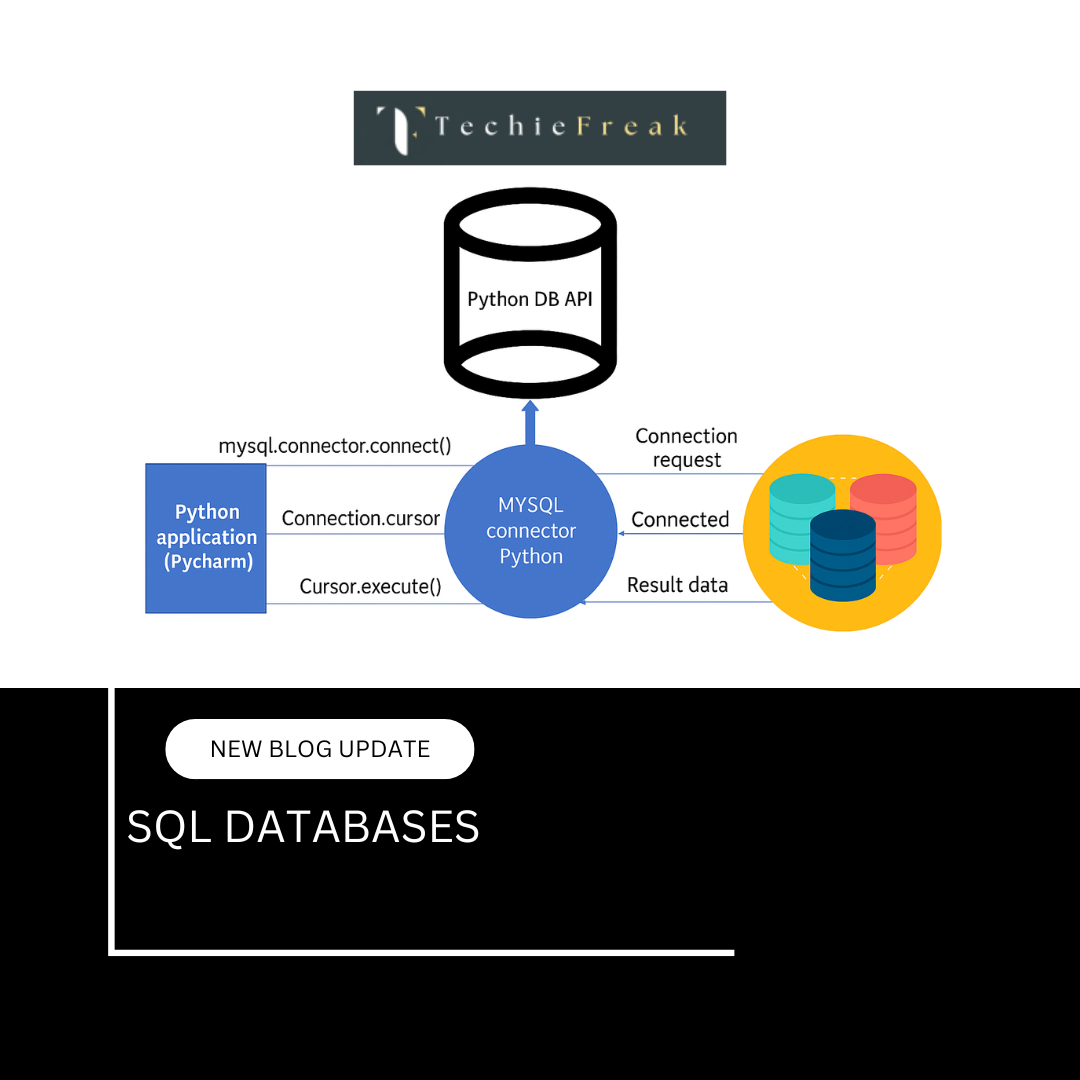
- Database APIs implemented using “PEP 249 — Python Database API Specification v2.0”
Database programming is divided into two large categories:
SQL Databases (Relational)
Structured query language (SQL) databases store data in tables, enforce relationships, and guarantee ACID properties.
Examples:
- SQLite
- MySQL
- PostgreSQL
- MariaDB
- Oracle
- SQL Server
Read more- SQL Databases
NoSQL Databases (Non-relational)
Designed for flexible schemas, high availability, and distributed systems.
Examples:
- MongoDB (document-based)
- Redis (in-memory key-value)
- Cassandra (wide-column)
- Neo4j (graph)
Python provides libraries for all.
Read more- NoSQL Databases
Database Security in Python
Avoid SQL Injection
Always use parameterized queries.
Manage Credentials Securely
Never hard-code passwords. Use:
- Environment variables
- Vault services
- .env files
Principle of Least Privilege
Only give required permissions.
SSL Connections
Use encrypted connections in production.
Real-World Architecture Patterns
Python Microservices with PostgreSQL
- FastAPI backend
- SQLAlchemy ORM
- PgBouncer for pooling
Data Analytics Pipelines
- Python ETL scripts
- SQLite for local caching
- PostgreSQL warehouse
High-Performance Systems
- Redis for caching
- PostgreSQL for transactions
- Python workers for queuing
Hybrid SQL + NoSQL
- MongoDB for flexible documents
- PostgreSQL for structured records
Common Pitfalls and how to avoid them
- Opening too many connections
- Forgetting to commit
- Blocking the database with long queries
- Fetching massive datasets without pagination
- Using ORM inefficiently (N+1 queries problem)
- Not handling exceptions
- Hard-coded SQL leading to low maintainability
Understanding these concepts allows Python developers to build:
- Scalable backend services
- Reliable enterprise systems
- High-performance data pipelines
- Database-driven desktop and web apps
- Production-ready distributed architectures
Next Blog- Databases in python
.png)
.png)
.png)
.png)
.png)
.png)
.png)
.png)
.png)
.png)
.png)
.png)
.png)
.png)
.png)
.png)
.png)
.png)
.png)
.png)
.png)
.png)